 THE MINERAL RHODONITE
- Chemistry: (Mn, Fe, Mg, Ca)5(SiO3)5 , Manganese Iron Magnesium Calcium Silicate.
- Class: Silicates
- Subclass: Inosilicates
- Group: Pyroxenoid
- Uses: ornamental and semi-precious stone and as a minor ore of manganese
Specimens
PHYSICAL CHARACTERISTICS:
- Color is typically pink to red or orange and even black.
- Luster is vitreous to dull to pearly on polished surfaces.
- Transparency: Crystals are generally translucent and rarely transparent.
- Crystal System is triclinic; bar 1
- Crystal Habits include crystals that have a blocky prismatic habit, however crystals are rare. More typically massive, coarse and fine granular aggregates.
- Cleavage is perfect in two directions forming prisms with a rectangular cross-section.
- Fracture is conchoidal.
- Hardness is 5.5 - 6.5.
- Specific Gravity is approximately 3.4 - 3.7+ (above average for translucent minerals)
- Streak is white.
- Associated Minerals are calcite,
pyrite,
microcline,
spessartine,
pyroxmangite and other manganese minerals. - Other Characteristics: May tarnish to a brown or black color upon exposure.
- Notable Occurrences include Ural Mountains, Russia; Broken Hill, Australia; Langban, Sweden, Menas Gerais, Brazil and Massachusetts and Franklin, New Jersey, USA.
- Best Field Indicators are color, black inclusions, lack of reaction to acid and hardness.
 Amethyst Galleries' Mineral Gallery MINERALS |
RHODONITE specimen rhd-2
$ 45.00
$ 45.00
Dims: 3.7" x 2.5" x 1.6" (9.4 x 6.4 x 4.1 cm)
Wt: 1 lb., 0.5 oz. (467 g)
Sterling Hill Mine, Ogdensburg, New Jersey, U.S.A.
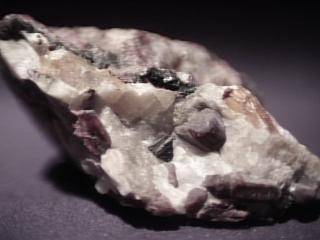
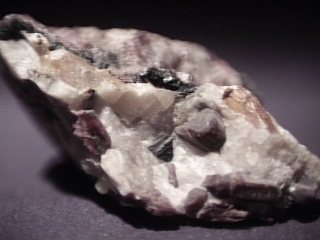
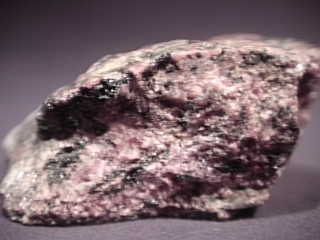
I have never seen Rhodonite from this locality before, let alone in such large crystals! It occurs both in massive and triclinic prismatic crystals. The crystals are partially obscured by white calcite, but all have good form, with definite but slightly rounded edges and smooth faces. The largest has visible dimensions of 0.6 x 0.2 x 0.2" (1.5 x 0.5 x 0.5 cm). Both crystalline and massive Rhodonite have a moderate to deep pink coloration and a pearly luster, and are dimly translucent at best. They make up the bulk of the specimen, but are intergrown with the calcite and heavily disseminated willemite and franklinite crystals. Exposure to UV radiation is the easiest way to pinpoint the willemite.
rhd-2 ($ 45.00)
Sterling Hill Mine, Ogdensburg, New Jersey, U.S.A.
RHODONITE specimen rhd-3
$ 45.00
$ 45.00
Dims: 5.4" x 3.7" x 3.0" (13.7 x 9.4 x 7.6 cm)
Wt: 3 lbs., 3.2 oz. (1.452 kg)
unknown
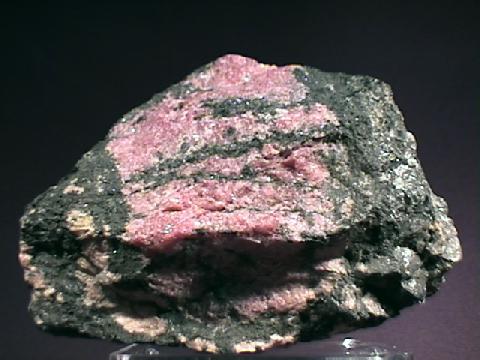
If you are looking for massive Rhodonite, this piece might well satisfy your wants! It is very large, and though it has a substantial amount of a black matrix rock present, there is still a majority of Rhodonite by weight. It has a deep pink coloration and appears to be nearly specular. Veins of the black material extend through it as is common for this material. There appears to be a few shards of broken quartz embedded in the black matrix on one end of the piece; it is colorless and transparent. I cannot accurately determine the quality of the material, but it has a lovely color.
rhd-3 ($ 45.00)
unknown

RHODONITE specimen rhd-4
$ 30.00
$ 30.00
Dims: 4.7 x 4.1 x 3.0" (11.9 x 10.4 x 7.6 cm)
Wt: 2 lbs., 14.7 oz. (1.324 kg)
unknown
This large hand specimen consists of a chunk of massive Rhodonite that is intermixed with manganese oxides and clear quartz. The material is not quite massive- there is some evidence of crystal form taking place- and should likely be classified as "specular". It has the moderately deep pink coloration that one expects of this material, and a pearly luster shines off of the tiny faces that make up its surface. Though the piece is too thick to show it, the material would likely be at least dimly translucent in 1/4" (6-7 mm) thick slices.
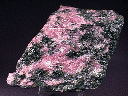
rhd-4 ($ 30.00)
unknown
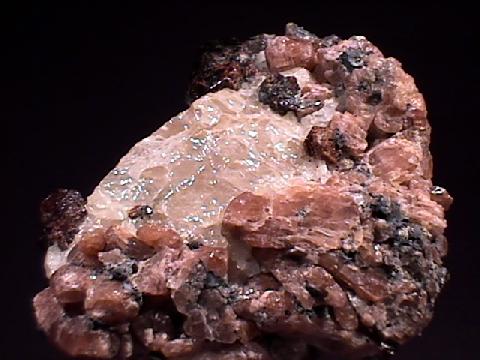
 RHODONITE specimen rhd-5
$ 100.00
Dims: 3.2 x 2.7 x 2.0" (8.1 x 6.9 x 5.1 cm)
Wt: 12.4 oz. (352.0 g)
Broken Hill Mine, New South Wales, Australia
Many triclinic prismatic Rhodonite crystals are partly embedded in the calcite matrix of this specimen. These crystals achieve lengths of up to 1.0" (2.5 cm), but most are damaged, and many are broken. Their form is rather rounded, but is still discernable- edges are moderately well-defined, and faces are generally smooth and possess a pearly luster. All of the crystals have a pale pink coloration with a tinge of orange and would be transparent, but are intensely internally-fractured. Accompanying them in the calcite matrix are several dodecahedral garnet crystals, most of which are also damaged. They achieve diameters of 0.6" (1.5 cm) and their form is good. All have a very deep red coloration and are essentially opaque. I would guess that these are spessartine garnets, as an associated manganese mineral to the rhodonite.
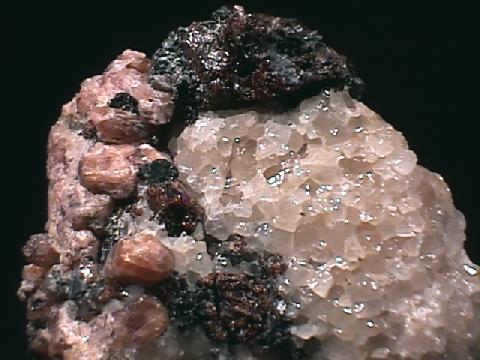
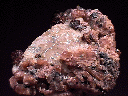 rhd-5 ($100.00)
Broken Hill Mine, New South Wales, Australia
RHODONITE specimen rhd-6
$ 40.00
$ 40.00
Dims: 4.5 x 3.0 x 2.4" (11.4 x 7.6 x 6.1 cm)
Wt: 1 lb., 11.9 oz. (792 g)
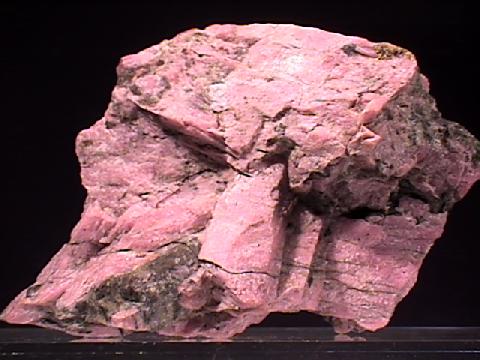
Broken Hill Mine, New South Wales, Australia
This hand specimen consists mostly of a seemingly amorphous chunk of massive Rhodonite. Though a heavy crack runs through a portion of it, the piece seems to be in good condition. One portion shows what almost appears to be a crystalline structure, but the presence of such a crystal is highly unlikely. It has the standard moderately pale pink coloration and a dull waxy luster, and is opaque. Several patches of yellow-to-dark-brown willemite are present in the Rhodonite- portions of these patches glow a bright green under shortwave ultraviolet light. One patch in particular constitutes a nearly complete crystal, though the aforementioned heavy crack runs through it. It appears to have a definite trigonal prismatic form with a hexagonal cross-section, though there is no termination to speak of.
rhd-6 ($ 40.00)
Broken Hill Mine, New South Wales, Australia
RHODONITE specimen rhd-7
$ 105.00
$ 105.00
Dims: 0.9 x 0.8 x 0.5" (2.3 x 2.0 x 1.5 cm)
Wt: 21.5 g w/ specimen box
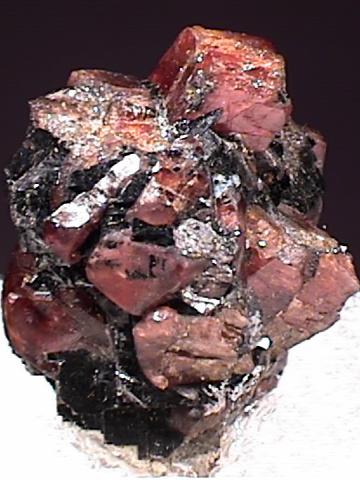
Broken Hill Mine, New South Wales, Australia
At least 8 separate and distinct Rhodonite crystals rest in the galena matrix of this thumbnail specimen. These crystals do not generally exceed 0.3" (8 mm) along any axis and are generally in moderate to good condition, as several are visibly damaged and a few are incomplete. Their triclinic prismatic form is rather badly warped, though a few faces are still discernable. Most of what appears to be form are actually cleavage planes on the damaged crystals. All have a beautiful deep red coloration and a waxy-to-pearly luster, and are translucent or dimly transparent, containing many internalinternal cleavage planes or fractures. The galena matrix in which they rest is also warped and somewhat cleaved, showing excellent cube-oriented cleavage planes and edges. The piece is hot-glued in a plastic specimen box.
rhd-7 ($105.00)
Broken Hill Mine, New South Wales, Australia
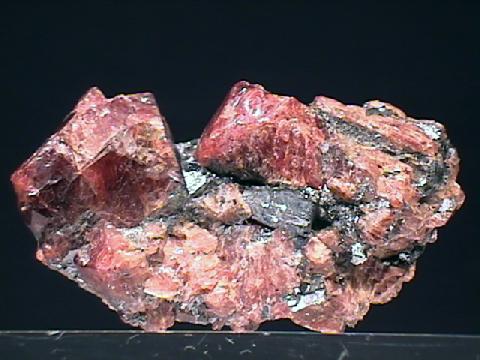
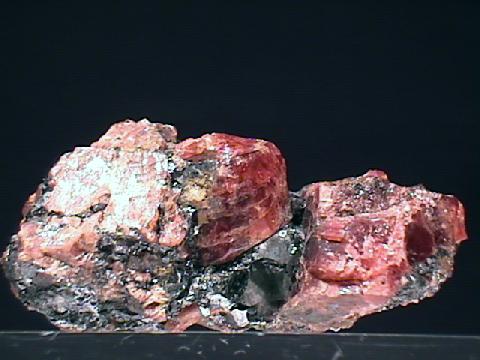
RHODONITE specimen rhd-8
$ 120.00
$ 120.00
Dims: 2.1 x 1.3 x 1.1" (5.3 x 3.3 x 2.8 cm)
Wt: 2.16 oz. (61.1 g)
Broken Hill Mine, New South Wales, Australia
Several large but incomplete Rhodonite crystals rest in the galena matrix of this specimen. The most complete crystal has dimensions of 0.5 x 0.4 x 0.4" (1.3 x 1.0 x 0.9 cm), though if complete, at least 2 others would be larger. This crystal shows evidence of a triclinic prismatic form , with a few moderately well-defined edges and a couple of incomplete but clean faces that possess a pearly luster. All have the classic deep red coloration of crystalline Rhodonite. While most of the material is merely translucent due to internal fracturing, several patches are definitely transparent, though clarity is not very good. The galena host shows the classic cube-oriented form, dark gray color, and slightly dull metallic luster.
rhd-8 ($120.00)
Broken Hill Mine, New South Wales, Australia
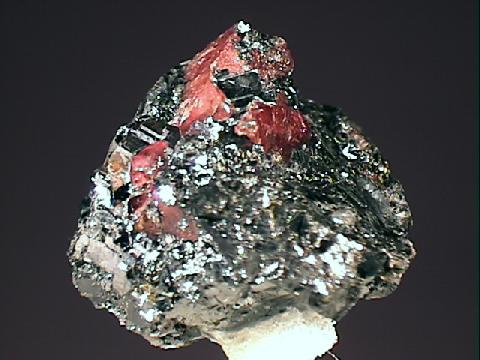
RHODONITE specimen rhd-9
$ 26.00
$ 26.00
Dims: 0.9 x 0.8 x 0.6" (2.2 x 2.1 x 1.6 cm)
Wt: 19.3 g
Broken Hill Mine, New South Wales, Australia
A few small Rhodonite crystals are embedded in the galena base of this specimen. These crystals are in fair condition, as most are cleaved or broken, and do not exceed 0.3" (8 mm) along any axis. All have a deep red color and a pearly luster, and are transparent and dimly clear due to intense internal fracturing. The galena base is also heavily broken, and the piece is affixed inside a plastic specimen box with a hot glue.
rhd-9 ($ 26.00)
Broken Hill Mine, New South Wales, Australia
 RHODONITE specimen rhd-10
$ 315.00
Dims: 2.6 x 2.2 x 1.8" (6.6 x 5.6 x 4.6 cm)
Wt: 14.7 oz. (420.4 g)
Chiurucu Mine, Dos de Mayo Province, Huanuco Department, Peru
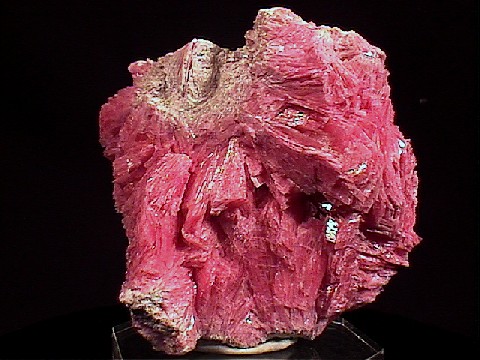
Though its appearance is deceptive, this unusual hand specimen consists of several intergrown Rhodonite clusters. These clusters contain crystals that extend to at least 1" (2.5 cm) in length and are generally in good condition, though many of the more exposed crystals are damaged or broken at their terminations. These crystals are highly irregular with respect to their aggregated, radiating triclinic blades, as opposed to the blocky crystals that Rhodonite usually forms. They have a bright, rose pink coloration and a pearly luster, and appear nearly silky in some respects. There is no host rock present. Actually, the form and habit of this material strongly remind me of those of kyanite. I did not think that this material was Rhodonite, but the occurrence at this locality was reported in Mineralogical Record's special issue on Peruvian mines and localities in July, 1997 (28:4, page 56). This is an excellent specimen from this locality.
 rhd-10 ($315.00)
Chiurucu Mine, Dos de Mayo Province, Huanuco Department, Peru
RHODONITE specimen rhd-11
$ 85.00
$ 85.00
Dims: 1.7x1.5x1.4" (4.4x3.8x3.5cm)
Wt: 3.50 oz. (99.1g)
North Mine, Broken Hill, New South Wales, Australia
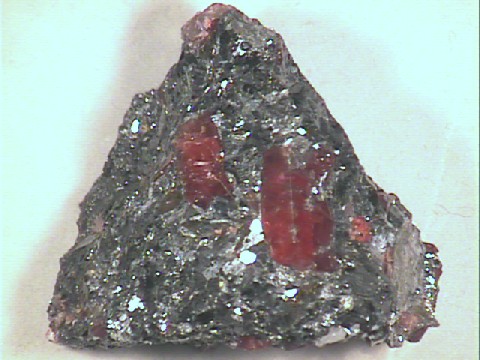
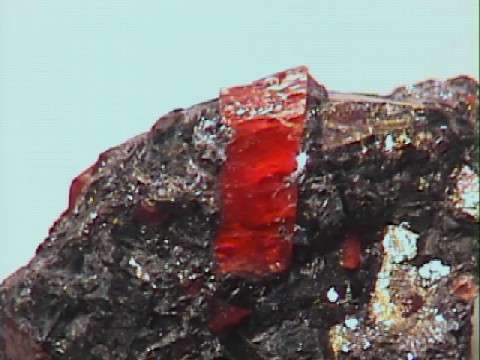
Embedded within a mass of intergrown galena crystals lie dozens of red, transparent rhodonite crystals. While these are mostly small, two of them visibly exceed 1cm in length. The clarity of the crystals is marred by internal fractures in various degrees - the small crystals on the bottom of the specimen are essentially opaque. Nearly all of the rhodonite crystals show some damage, and there are no natural, complete terminations visible. The largest crystals (and many smaller ones) do have good crystal faces and show a splintery fracture where broken.
rhd-11 ($ 85.00)
North Mine, Broken Hill, New South Wales, Australia
RHODONITE specimen rhd-12
$ 42.00
$ 42.00
Dims: 1.97x1.42x1.26" (5.0x3.6x3.2cm)
Wt: 4.30oz. (121.6g)
North Mine, Broken Hill, New SOuth Wales, Australia
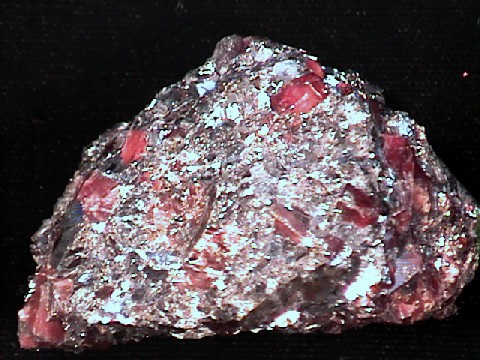
This is a chunk of galena that is probably 25% full (by volume) of rhodonite crystals - there are a lot of them here. The galena is all cleavage surfaces with a high luster. The rhodonite is translucent and a medium-red color. While most of the crystals show some damage from being separated from their home, many of them are in excellent shape. There are tiny patches of other mienrals present as well, including something green, something brassy (likely chalcopyrite), and a flat surface that is irridescent (but it might just be more galena).
rhd-12 ($ 42.00)
North Mine, Broken Hill, New SOuth Wales, Australia