 THE MINERAL ENSTATITE
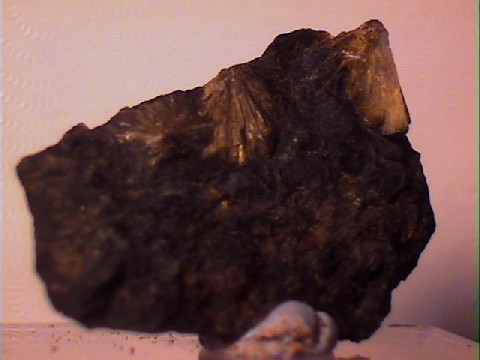
- Chemistry: MgSiO3 , Magnesium Silicate.
- Class: Silicates
- Subclass: Inosilicates
- Group: Pyroxene
- Uses: As mineral specimens and some varieties are cut as gemstones.
Specimens
Enstatite is a relatively common mineral and is found in metamorphic and some igneous rocks as well as in stony and iron meteorites. It forms a solid solution series with the minerals hypersthene and
Enstatite is an orthopyroxene or a pyroxene with an orthorhombic symmetry.
At high temperatures, enstatite's structure changes to a structure with a monoclinic symmetry, a clinopyroxene or more specifically,
Enstatite has a couple of ornamental and gemstone varieties. A weathered variety that has a submetallic luster and a bronze like color is called "bronzite". It is sometimes used as an ornamental stone. Both enstatite and hypersthene contribute to the bronzite variety. An emerald green variety of enstatite is called chrome-enstatite and is cut as a gemstone. The green color is caused by traces of chromium, hence the varietal name.
Enstatite would form more commonly in igneous rocks if it were not for the abundance of iron in most magmas. As a result, enstatite is more commonly seen in highly metamorphosed rocks called granulites. It commonly forms from the alteration and de-watering of the amphibole mineral anthophyllite, (Mg, Fe)7Si8O22(OH)2.
PHYSICAL CHARACTERISTICS:
- Color is typically white, colorless, gray, light brown or pale green.
- Luster is vitreous to pearly. Weathered specimens can have a submetallic luster ("bronzite").
- Transparency: Crystals are generally translucent and rarely transparent.
- Crystal System is orthorhombic; 2/m 2/m 2/m
- Crystal Habits include rare individual crystals that have a stubby prismatic habit. More typically massive or in coarse lamellar or fibrous aggregates.
- Cleavage is perfect in two directions at nearly 90 degrees.
- Fracture is conchoidal.
- Hardness is 5 - 6.
- Specific Gravity is approximately 3.2+ (slightly above average for translucent minerals)
- Streak is white.
- Other Characteristics:
Index of refraction is approximately 1.65. - Associated Minerals include iron and stony meteorites, augite, feldspars and certain types of garnets.
- Notable Occurrences include the Tilly Foster Mine, Brewster, New York; Boulder, Colorado; Jackson Co., North Carolina; Lancaster Co., Pennsylvania and Bare Hills, Maryland, USA as well as many localities from around the world especially in India, Burma and Tanzania.
- Best Field Indicators are color, crystal habit, hardness, cleavage, index of refraction and luster.
 Amethyst Galleries' Mineral Gallery MINERALS |
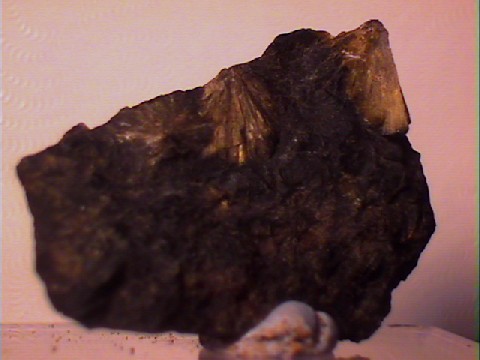
$ 25.00
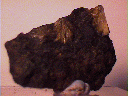
ens-1 ($ 25.00)
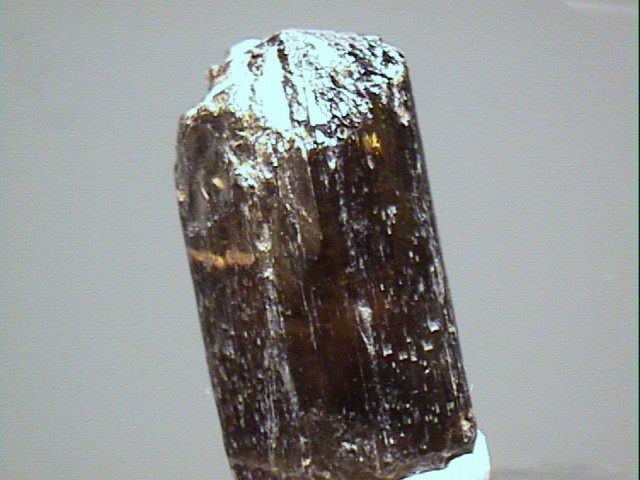
$ 36.00
ens-2 ($ 36.00)