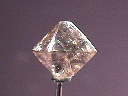
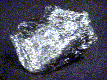
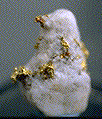
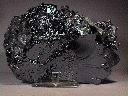
- Chemistry: Cu3Zn2, Copper zinc
- Class: Native Elements
- Subclass: Metallic Alloys
- Uses: Only as mineral specimens.
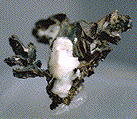
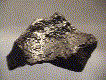
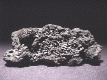
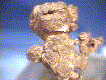
Specimens
Brass is classified as an element dispite the fact, that in chemical reality, it is a compound. Minerals like brass are alloys with metallic bonds that are very similar to the more pure metallic elements and are thus classified as elements.
PHYSICAL CHARACTERISTICS:
- Color is yellow to brassy yellow.
- Luster is metallic.
- Transparency: Specimens are opaque.
- Crystal System is isometric.
- Crystal Habits are limited to tiny grains.
- Cleavage is absent.
- Specific Gravity is 8.4 - 8.7 (man-made brass)
- Streak is brassy brown.
- Notable Occurrences are limited to two localities in Siberia, Russia; Tolbachik Volcano, Kamchatka and Vol'sk-Vym Ridge, Middle Timan.
- Best Field Indicator is color, locality, density and rarity.
 Amethyst Galleries' Mineral Gallery MINERALS |
Popular Members of the Elements Class